Search Engine Optimization, or SEO in short, has been around ever since AltaVista took the Internet by storm. That was in the mid to late 90s, long before Google appeared. Everyone wanted their website to rank highest in the search results for specific keywords or topics. With SEO, online marketers got free traffic to their websites directly from the search engines. But with ChatGPT and Google Gemini now, search is dead, and so is Search Engine Optimization (SEO). Say hello to RAO.
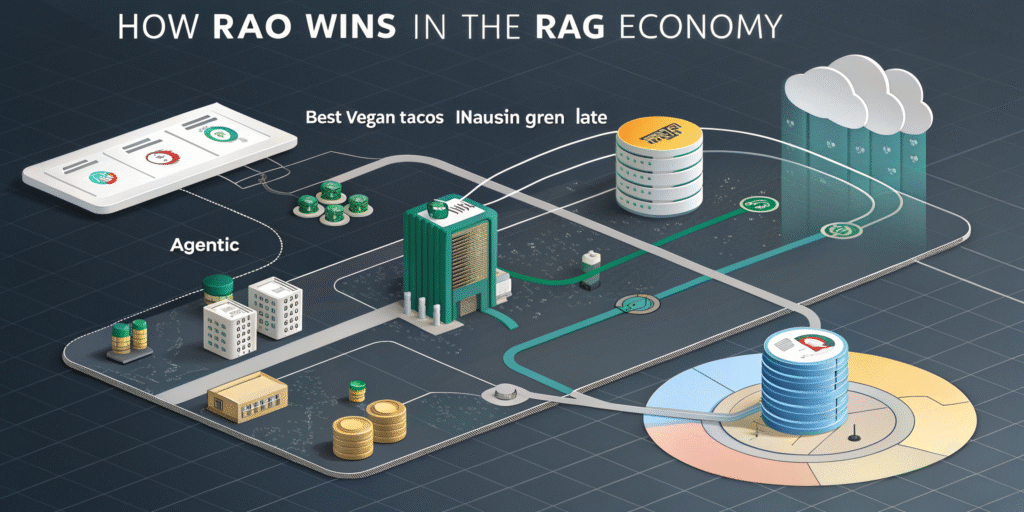
The class “Internet Rockstar” SEO is dead: the robots killed it off. People aren’t hammering search queries into search engines anymore. They’re now using ChatGPT or Google Gemini to find what they want. Both Large Language Models (LLMs) use a process that is called RAG (Retrieval Augmented Generation). They use “Retrieval Augmentation” (RA) to retrieve information from the Internet for use in their reasoning and within their results. You can flush all the keyword tools down the toilet, because human keywords no longer matter. Agentic keywords matter.
How Retrieval Augmentation works
When you prompt an LLM with “Where can I get Döner Kebab in Bonn, Germany after 11 pm on weekends?“, it’ll go on and search various Internet sources to find the answer to your question. That is retrieval augmentation.
ChatGPT executing RAG with web search Retrieval Augmented Generation (RAG) is the process of Retrieval Augmentation in combination with the output generation of the LLM. In the first step, the LLM determines if your query requires Internet research. If it does, the LLM will prepare a structured approach, including the sources to use and their usage. Gemini currently has most sources at hand, as Google integrated everything into it. Once structured, it will execute the structured retrieval of the required information.
The Retrieval Augmented Generation (RAG) process flow. Source: NVIDIA
The retrieved data is filtered, analysed, and ingested into the LLM, alongside the user’s original prompt. The LLM can then generate the output for the user’s prompt using the retrieved information. With RAG, the LLM is not just fed the prompt, which it has to answer from its model knowledge, but ideally already the correct information to answer the user’s prompt, question, or inquiry. RAG was initially developed to fill the knowledge gap and provide LLMs with the most current knowledge possible, including real-time updates. RAO, or Retrieval Augmentation Optimization, is the new game in town. As a business, your goal is to be featured in as many user prompts as possible, and in a positive light. This is where RAO comes in, helping you optimize your online presence for the new digital landscape.
RAO done right
RAO is just SEO for robots. That’s only half the truth. With Search Engine Optimization, you optimize your site for specific keywords to rank high in search results. Your website would then receive traffic from search engines, as users click on the search results. RAO is different. The LLMs don’t just do a single Internet search and use the top 3 results. Don’t believe me? Just ask ChatGPT or Gemini how they do it, because they’ll happily explain to you how they would specifically research for your business.
Gemini 2.5 Pro explaining its structured RAG approach.
The LLM will name the sources it’ll use as well as the various keywords used to search for required information. One key difference is the use of different and trusted sources. Backlinks and rankings rarely really matter; most keywords are “long tail keywords”. It’s just not sufficient to rank your website high on any search engine. Your business needs to be referenced in various sources, and your business information must be complete, consistent, and up-to-date across all information sources. Nothing is worse for RAO than conflicting or outdated information.
ChatGPT explaining its RAG approach and search terms used
As a restaurant, if your menu isn’t consistent across search engines, maps, and delivery platforms, the LLM may drop your business from the results. The same applies to all other business information, such as opening hours and payment methods. The prompt for “Which Kebab shop in my area is open after 11 pm, accepts Amex, and is safe for women?” will have the LLM execute a variety of long-tail keyword searches and metadata queries on various data sources. If you don’t have all the necessary information published and current, you’ll be filtered out.
Effective RAO strategies
In SEO, we identified the search intents and derived the keywords from that. In RAO, we need to do much more than that. We need to identify the demand of our prospective customers and ensure that all required information is present on multiple websites, referencing our business. Here are the essential parts of RAO that you need to do as a marketeer.
- Ensure your business is referenced (no backlink needed) on various websites that rank for a variety of keywords, including long-tail keywords. There needs to be at least 10–15 different websites, like news sites or communities.
- Google Maps and business directories need to be up to date and have all the necessary business information: opening hours, payment methods, and menus, products, or services available. You need to cover 100% of the information on Google Maps, which is a good indication of what information to present everywhere.
- X, Instagram, and Reddit are king: if your business is a no-name on X, Instagram, or Reddit, you’re not going to make it. Many of the LLMs were trained on Reddit and X data. If users recommended your business in subreddits, you’ll likely end up in the RAG chain.
- Use the LLMs themselves to tell you what their approach to specific user demands is. Consider the products you sell to your customers and the situations where they need them. Then ensure you are covered in the respective prompts.
Local information is more crucial than ever in the world of RAO. This includes not only the region you serve your customers in, but also the details of your business location. Any discrepancies or inconsistencies in this information could lead to your business being filtered out by the LLM’s security measures. There aren’t yet any fundamental RAO analytics tools out there, and users have overtaken vendors with their speed of adoption. Currently, the best practice is to keep a list of demand scenarios for your customer personas and the corresponding prompts. You can check that list regularly to see if your business is covered. The traffic to your website has become a meaningless metric, as people will now rely solely on LLMs.
Reddit users discussing the best Döner Kebab in Bonn, Germany
In the SEO days, social networks were a source of trust for your website. In today’s world, they have become a source of information to verify the accuracy and timeliness of information around your business. You should regularly post and participate on social media platforms like Reddit, X, Instagram, and TikTok to ensure LLMs are aware that your business remains active, open, and offering its services. Posts’s text descriptions on video platforms like YouTube, Instagram, and TikTok become more relevant as LLMs will primarily rely on these. If you extend your opening hours or have a special deal on a weekend that you announce on TikTok or Instagram, the summary of that needs to be in the text description; otherwise, the LLMs won’t get it.
Public MCP will kill websites.
Your website has already become irrelevant, and most businesses fail to execute even the simplest of UX/UI design principles. Websites and web apps are dead. They will stick around for some more years, but their importance is becoming less and less dominant. The “Model Context Protocol” already allows LLMs to execute actions. You need to prepare for a world in which your online shop, food ordering system, or appointment calendar supports MCP. In the future, LLMs will handle ordering, booking, and payment on behalf of their users. That’s not a 10-year distant future; that’ll happen in the months to come.
How MCP currently works for LLMs; Source: Descope.com
RAO is the first step to prepare your business for MCP conversions. People no longer search websites to buy things on them. The only part that is currently left is the “buy” action, and MCP will very soon replace that. Much of that is currently under research, and standards for public MCP are being developed. As with everything in AI, the future is likely tomorrow morning and not just in a few years. Large web platforms (Booking.com, Uber Eats, etc.) will become less and less relevant on the web, and your approach to making more sales through your website will no longer be as crucial. The main question for your business today is whether it is prepared for revenue optimization for LLMs with MCP through RAO.
Future outlook
The day your CEO talked about SEO, it was dead. Even Cindy from accounting knows that it is. Search engines have long surpassed the hype cycle. RAO is just getting started on it. Gemini will ultimately replace Google’s search engine; we’re already seeing the early stages of this transition, with Gemini appearing at the top of every Google search. Websites become irrelevant.
Gemini recommends Schawarma places in Bonn, Germany.
LLMs are already in phones, tablets, cars, computers, and TVs. They will expand further, and you cannot fight the change. Someone driving in a car with Android Automotive (AAOS) will not use your website to order a pizza. They will use Gemini through voice commands, and Gemini will use MCP to execute orders on their behalf. Google will likely charge you for it.
You can try to fight this future by contacting your politician, writing letters to the government, or protesting on the streets. It won’t change. This is not a distant future; this is the present already. A present that is now quickly making its way out of the software labs and out into the real world. Book stores didn’t die because Amazon was cheaper; they died because Amazon delivered a more convenient technology that just worked. Don’t become what bookstores were in the early 2000s: late adopters that tried to fight the future and failed. Start your RAO strategy today and plan for a future in which business is done through MCP.
Share this content: