AI agents are not your run-of-the-mill chatbots. They are autonomous, making programmed decisions, performing tasks, and interacting with the world independently. This level of self-execution has opened up a vast new frontier, and savvy investors are starting to take notice.
After a significant surge, the sector is now experiencing a cooling-off period. This presents a unique opportunity to position yourself before the next upswing. Delve into the most innovative and promising projects in the AI agent niche, and explore how they could revolutionize your investment portfolio.
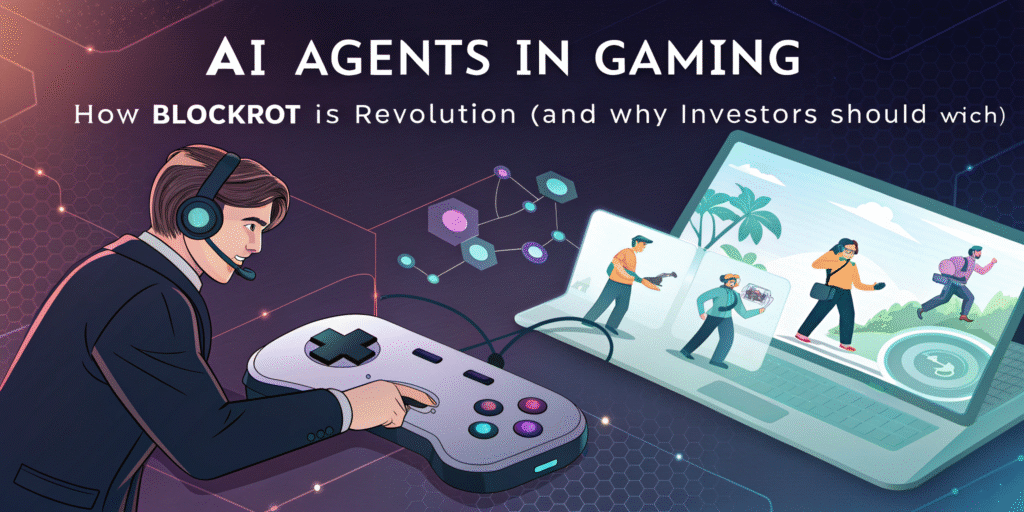
1. Blockrot: Live-Streaming AI Agents
Blockrot isn’t just another AI chatbot with some fancy branding. It’s an autonomous streamer that plays games, makes decisions, and interacts with its audience in real time — no script, no prompt.
Its main playground? Minecraft.
But the key innovation here is how viewers shape the stream through chat. Every decision, every outcome can be influenced live by the audience. That changes the game completely.
Its BROT token may have started as a meme. Still, the team is pushing hard to give it real utility within the AI-powered streaming experience.
This is what makes Blockrot exciting: it’s not just content. It’s interactive, immersive, and hints at where crypto x gaming x AI is headed next.
If it gains traction, this could go far.
2. Virtua (Virtuals Protocol): Tokenized Co-Owned AI Agents
This is the big dog in the room. Virtuals has built a full stack for creating, launching, and co-owning AI agents that can generate revenue.
Think: autonomous bots that post on X, trade, create memes, or chat on Telegram — and you own a slice of their earnings.
They’ve launched Initial Agent Offerings (IAOs), where each AI agent comes with its token. The platform is powered by $VIRTUAL, which is paired with every agent token in liquidity pools. That makes $VIRTUAL the reserve asset of the ecosystem.
Valuation? Around $2 billion.
Yes, it’s had a massive run-up. But its positioning as the core protocol of this trend makes it one to keep on your radar. Not early here — but foundational.
3. ai16z: The Autonomous Hedge Fund
AI 16z positions itself as a decentralized, autonomous hedge fund. Its AI agents manage funds, invest across projects, and optimize performance — all without human voting or micromanagement.
Everything is transparent and on-chain. But what makes it unique is the Eliza framework. This tool lets developers build AI agents that remember context, customize behavior, and act independently.
Eliza trended #1 on GitHub for a reason.
Market cap? Around $1.5 billion.
It’s not early-stage, but their roadmap includes building a full agent infrastructure platform, which could open the door to a much larger ecosystem.
4. BOO AI: AI Agents Meet Real-World Data
BOO AI is a partnership between IoTeX, Eliza, and AI 16z — and it’s a play on combining physical-world data with autonomous agents.
Their platform, Quicksilver, enables developers to build agents that can act based on things like GPS, weather, or motion sensors.
Their agent, BOO AI, uses the SENTAI token. But the real value here might come from the broader use case: smart homes, autonomous vehicles, and cities optimized by decentralized AI.
This is one of the more futuristic plays — and still early.

5. VVAIFU: The fun of AI Agents
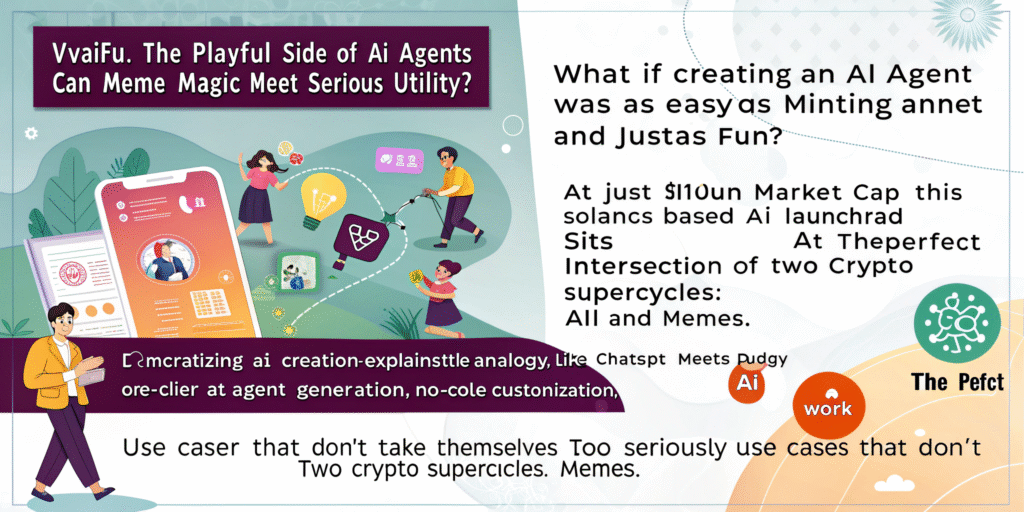
Built on Solana, VFU is a launchpad for AI agents where anyone can spin one up in seconds. You connect your wallet, set traits and functions, and boom — your agent is live with its token.
Every launch burns VU tokens, making it deflationary by design.
Sits at a sub-$100M market cap. Compare that to Virtuals at $2B, and you can see the upside.
Plus, it’s at the intersection of AI and meme coins — two of the cycle’s strongest narratives.
This is a high-risk/high-reward bet.\
6. Swarms: Managing Armies of AI Agents
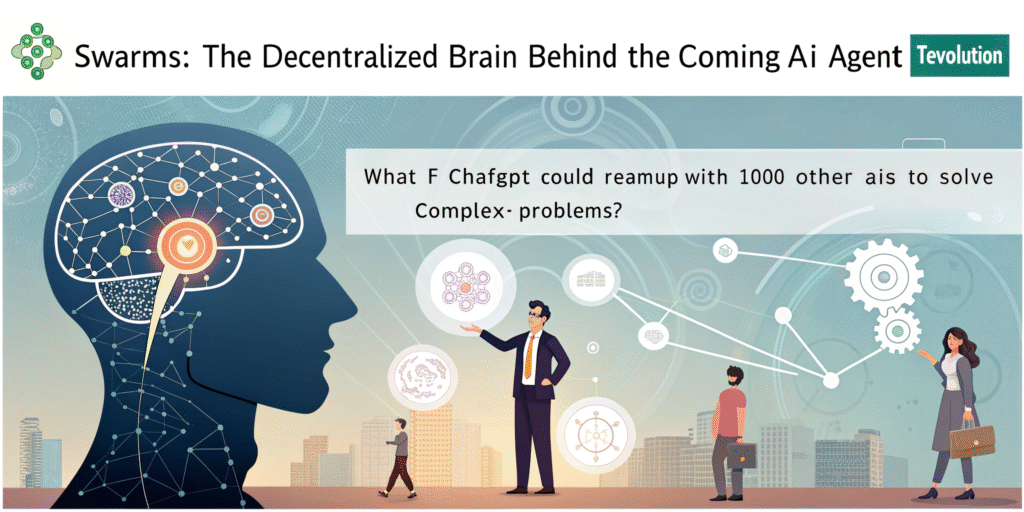
Swarms is building a framework for large-scale agent collaboration. Instead of one AI agent doing a task, you get networks of them working together, managed through customizable logic.
It’s open source, decentralized, and driven by a founder who wants to ensure that no single company controls the AI future.
Currently sitting at a ~$200M market cap.
Still early, but the vision is bold — think decentralized infrastructure for millions of AI agents.
7. Zerebro: Social AI Agents for X, Instagram, Telegram
Zerabro is focused on social content. Its AI agents generate, post, and manage engagement across social platforms.
But the kicker is their Zerai framework — a tool to deploy your own AI social media agents. This is being integrated into VFU, giving both ecosystems a boost.
Backed by a firm founder with a big crypto Twitter following, and a product that has real use cases for creators and marketers.
This one’s more under the radar than the others — but potentially powerful.

Share this content: